Africa / Kora

PAN M 360 at Nuits d’Afrique 202 | All United by The Kora

by Michel Labrecque

The kora is one of the most fantastic African inventions. This 21-string harp, made of calabash (a large, very hard squash) and cowhide, invented at the end of the 17th century, allowed West African griots to create complex music with very rich harmonic possibilities.

My first auditory contact with this instrument occurred in the summer of 1979 (that doesn’t make me any younger…) in a post-hippie bar in Olympia, in the United States, during a community radio meeting. The Mandingo Griot Society record was playing and everyone at our table stopped talking; some started dancing. “What is this instrument, it’s so beautiful,” someone cried. We had to do our research later. There was no internet or cell phones. 

From the mid-1980s, the African wave swept across the West, bringing us multiple koras in its wake.  

The Night of the Kora has become a staple of the Nuits d’Afrique festival. To embody it in 2024, who better than Prince Diabaté, nicknamed the “Jimi Hendrix of the kora”. Originally from Guinea Conakry, from a lineage of griots, these traditional Mandingo singing journalists, Prince Diabaté is an innovator of the kora, having sometimes merged with modernity, the WahWah pedal, rap and symphonic music. The prince of alternative Kara. 

However, at Gésu, this July 14, Prince Diabaté presented himself in a more intimate format, solo, with his all-red kora, with his name engraved on it. Is it for lack of resources or for concern for authenticity? Regardless, the result delighted the rather large audience.

Prince Diabaté completely merges with his instrument. He manages to extract unknown, unpublished notes, sometimes in cascades, sometimes gently. He also sings in a pleasant voice, or declaims words of traditional songs or compositions. He also sometimes hits the body of his instrument with force, to create rhythmic surprises. 

For me, there is something strangely timeless about this performance. I can not explain it. This sound, based on centuries-old traditions, is surprisingly current. 

Opening act, Malian-turned-Montrealer Diely Mori Tounkara. “We’re going to have fun tonight,” he said from the outset. Diely is less flamboyant than Prince Diabaté, but his more meditative playing, using a lot of reverb, is not without interest, quite the contrary. This distinguished artist of Montreal diversity gave us an excellent time. To cap off the evening, the two musicians played together, alternating improvising one after the other.

The audience, predominantly white but with a significant African component, was won over. There were no more races, languages, differences. Everyone was united by the kora.

Photo Credit: Peter Graham

Publicité panam
Dancehall / Reggae

PAN M 360 at Nuits d’Afrique 2024 | Queen Omega, From the Top of Her Throne

by Sandra Gasana

Willy B Rose was the host for the long-awaited show by the Queen of Reggae, here to accompany Entourloop, with whom she’s been collaborating for several years now. Much to my surprise, we kicked off with Queen Omega, the majority of the audience having come to see the French group who has many fans in Montreal.

The Trinidadian reggae icon was accompanied for the occasion by The Royal Souls, made up of Ons Barnat on keyboards, Thomas Broussard on guitar, Thierry “Titi” Lechauve on bass and David Dub Akom on drums.

First, the musicians set the stage for Royalty, whose voice can already be heard in the distance. And what better way to kick things off than with Fittest, from her most recent album Freedom Legacy, one of her signature tracks. With her long orange dress and legendary signature turban, she takes to the stage like a queen. She segues seamlessly into Make a Sacrifice, during which there was a minor technical hitch with the microphone, followed by Judgement, with audience participation on the chorus. She jumps around the stage, does military steps at times, in short, this Queen is in good physical shape.

“It’s good to be here in Montreal,” she says, not speaking the language of Molière despite her many stays in France. On Dirty Minds, she talks about corruption, which she wants to eradicate, before continuing with Bite the Dust.
“I feel your energy, thank you very much. It’s time for renewal,” she announces.
She does a magnificent cover of Amazing Grace, which she has renamed Jahmazing Grace, adding her own little touch, mixing reggae and dancehall. At times, we felt like we were in a church in the USA. She jumped in the air, danced with the guitarist, sometimes in a trance, singing Glory and ending with a Hallelujah.

She takes a leap back in time when she sings Ganja Baby, from her 2004 album Away from Babylon. “Kudos to the Canadian government for legalizing ganja here. Weed isn’t a drug, it’s a plant, but you shouldn’t abuse it,” she reminds the audience, who seem to appreciate her lyrics.
She’s completely on fire during the track Elevate, but my favorite moment of the evening is undoubtedly when she shares a new sound like Head Above the Water, with its subsequent message of encouragement. “Even when things seem insurmountable, tell yourself it will pass! Don’t give up!” she said to appreciative applause.

“Do you remember I Can’t Breathe? Do you remember Black Lives Matter?” she asks the crowd before playing Elimination. She does a few dance steps, even does the robot at one point, in addition to dancing and jumping around the stage. One thing’s for sure, this queen has an undeniable stage presence and is tireless.
She couldn’t leave without paying tribute to women, which she does in Black Woman. “Encourage women, love them, worship them!” she declares. And addressing women directly: “Women, keep your crown on your head and keep your head up! I love you.”

She saved the best for last, including the global hit that made her world-famous, the track No Love, followed by Local, on which she claims to be an international singer and ambassador of Reggae. This gave the crowd a chance to let off steam and get ready for L’Entourloop.

I was left wanting more. An hour’s performance wasn’t enough for the spectators who came to see Queen Omega. Let’s hope she comes back for a full show very soon.

I had time to see a few minutes of Entourloop before leaving Mtelus. I didn’t know the band or the concept at all, but what I understood was that they’re a DJ duo of a certain age, who mix reggae sounds as well as dancehall, dub, ragga, downtempo and hip-hop, accompanied by a trumpet player and two MCs who liven up the evening by singing and rapping mainly in English. The room was mainly made up of French people, and on the screen behind them were animations of all kinds. When I left, people were having a blast.

Photo credit: Nuits d’Afrique

Publicité panam
Afro Latin / Chaâbi / Flamenco / Maghrebi

PAN M 360 at Nuits d’Afrique | Youba Adjrad, Algeria’s Great Pop Voice

by Alain Brunet

If fans of raï, chaâbi, Arabo-Andalusian or even salsa, tarab and Amazigh culture (indigenous to the Maghreb) knew about the immense voice of Algerian singer Youba Adjrad, Fairmount would have been shaken. Such power singers are few and far between.

Youba Adjrad was born in Algeria in 1991, took his first steps in music at the age of 14, studied music at the age of 17, and was inspired by his chaâbi-singing father to enroll in a classical music school in 2009. On Algerian radio, Youba improvises a few Algerian chaâbi classics and even a song of his own. In 2012, at the age of 21, he took part in the national Alhan Wa Chabab (Algerian Super Star) competition, then reached the final of Arabe Idol (season 4). Some consider him to be one of the best Arab voices of the current period. The thirty-something certainly comes from pop and reality TV, but he frees himself from it and distinguishes himself from it.

Believe me, this is no show-off. I was there for the first set on Friday night and wow, what a voice! The groove is purely Maghrebian but also Afro-Latin, the result of Youba Adjrad’s encounter with percussionist Youcef Grim. Montreal musicians Bertil Schulrabe, Carlo Berri, Rafik Abdeladim and Ryan Kaouene are also mentioned as having taken part in the project.

The few dozen people on hand were very happy to be there, despite the low attendance for an artist of this calibre. Next time, we predict, it will be very different.

Publicité panam
Africa / rap

PAN M 360 at Nuits d’Afrique 2024 – Def Mama Def, Two Sisters in Art  

by Sandra Gasana

That’s what came out of the show put on by Defa and Mamy Victory, aka Def Mama Def, last night at Le Ministère, during the 38th edition of the Festival Nuits d’Afrique. The explosive Senegalese female duo of the moment is much more than a duo, they’re sisters in art. Dressed in skin-tight hooded jumpsuits, wearing smoked glasses, they arrive on stage accompanied by Simsa on drums and Mr No One on turntables.
Between rap and singing, the two artists complement each other and engage in a musical dialogue on stage. “We almost didn’t sleep last night, we were so excited,” confides Mamy Victory, her hair dyed blue for the occasion. As well as singing and rapping, they dance perfectly well, play percussion, all with an electrifying energy. “The next song is for lovers,” they tell us, before teaching us the lembel, one of Senegal’s many dances.

In front of a still shy audience, they managed to raise the temperature in the room on the track Jigeen, which means woman in Wolof. On several occasions, they address the crowd in their native tongue, much to the delight of the Senegalese in the room. “This time, we’re going to the north of Senegal”, warns Defa, as she performs dance steps from her homeland and gets the audience singing along. The two artists tease each other a lot, especially when they tackle the delicate question of ethnicity. “Y’a pas que les Toucouleurs, y’a aussi les Sérères”, Mamy Victory defends herself.

Another highlight of the evening is the song Oh Maliko, on which tradition and modernity are fused.
The second half of the concert opens with percussion, as they reveal their talents with this instrument. The two women return to the stage equipped with sticks, and it’s immediately clear that the level of intensity is about to rise. The complicity of the two women is evident throughout the performance. Through glances, smiles and improvised choreography, you can tell they’re enjoying playing together, like yin and yang, waltzing between softness and hardness. Softness in Defa’s honeyed voice when she pushes the note, and hardness at times during Mamy Victory’s torrid raps.

Another electrifying moment is undoubtedly the song Dieuredieuf, released in 2022, which means thank you in Wolof. “We’re going to sing for the whole of Africa”, they announced, in a discotheque-like atmosphere. We were even treated to a little cardio session during which they got our arms moving, before returning to percussion accompanied by their DJ, who also got in on the act. My favorite track was Kalanakh, from the Oh Maliko EP, which they described as “an alarm bell announcing their next album” during my interview with them. Indeed, 2025 will be the year of Djar Djar, the duo’s debut album. Before closing their show, they paid tribute to all the artists who had gone before them, including Positive Black Soul (PBS) and Orchestre Baobab, to name but a few. The only disappointment is that the Senegalese community didn’t turn out in large numbers to welcome the two sisters in art, but let’s just say that this is their first concert in the city, and certainly not their last. Until then, let’s hope the word of mouth will do its job.

Publicité panam
Brazilian / Forró / Samba

PANM360 at Nuits d’Afrique | Alberto Salgado Turns Balattou Into a Percussive Laboratory

by Michel Labrecque

The Brazilian songwriter told me in an interview: “I make MPB, Brazilian percussive music,” making a play on words with the real meaning of MPB (Brazilian popular music). We were able to see, Thursday evening at Balattou, that he was speaking the truth. 

The guitarist and singer from Brasilia offered us a two-part concert, largely consisting of pieces from his records Além do Quintal and Cabaça de Agua, as well as the upcoming album Tutorial de Ebo. The temperature quickly rose in the club dedicated to world music.

Alberto Salgado is surrounded by a small musical group: Marcelo Marinho on cavaquinho, Valerio Xavier on pandeiro (small drum) and other various percussions, and an occasional triangle player (yes!). This contrasts with the multitude of instruments, including electronic, that we hear on these studio recordings. On the other hand, the guides are overflowing with communicative energy. Enough to supply Place Ville-Marie with electricity!

Marcelo Marinho is the John McLaughlin of cavaquinho, this tiny guitar with high notes. He multiplies his solo flights, dropping notes by tens per second. It is he who provides the melodic foundation of the group, with the voice and guitar of Alberto Salgado.

Salgado’s guitar is very percussive, which brings us back to this idea of ​​music very focused on rhythm. There are forró, samba, Afro-Brazilian rhythms, often very subtle. It is an essential force in Brazilian music, beyond Bossa Nova and the forms better known here. This is what made Balattou transform into a percussive laboratory. In addition to the musicians, the entire audience was stamping their feet or tapping on the table or their thighs. Those who weren’t tapping got up to dance.

Alberto Salgado and his musicians speak very limited English, which has deprived them of sharing with us their worlds beyond music. But that did not prevent the public from feeling communion and the desire to share.

Publicité panam
Africa / West African traditional music

PAN M 360 at Nuits d’Afrique | Guinea in Circus!

by Alain Brunet

The first “big” show of the Nuits d’Afrique 2024, Afrique en Cirque unfolded on Wednesday at Montreal’s Olympia to a full house. There was a big appetite for this Afro-Quebec circus, this time centered on Guinean culture, typical of West Africa.

“I’ve worked for just about every circus in Quebec on the international scene, and I felt there was something missing: African acrobatics. So I wanted to put on a show about my native Guinea,” explains Yamoussa Bangoura, founder of the troupe. A multi-instrumentalist and acrobat, the leader of Kalabanté has delved into the traditional legacy of Guinea, his homeland, to create a series of musical-circus tableaux, spanning some 90 minutes.

Dynamic, impressive, thrilling, entertaining, humorous, festive, martial, athletic, virtuoso. These are just some of the epithets to describe these acrobatic and choreographic maneuvers of high acrobatics. Four men and two women, some of them amazing contortionists, adapt circus arts to African traditions. They reproduce everyday, traditional practices such as fishing, the market and village feasts, not to mention a few nods to Western life, such as this hilarious number by muscular males à la Village People.

Three musicians accompany them (bass, drums, saxophone, effects pedals, etc.), not to mention the ringmaster, who is in fact the main musician (kora, djembé singing and other percussion instruments) as well as being an acrobat and Kalabanté’s artistic director. Based in Montreal for over two decades, Yamoussa Bangoura is well acquainted with some of the world’s most innovative circus practices, far beyond Cirque du Soleil. A seasoned percussionist, he has instilled the practice of percussion in his fellow acrobats, who regularly contribute to pounding large drums whose horizontals are somewhat reminiscent of Japanese kodo.

The musical direction is hybrid, between traditional Mandingo music and modern Western music (funk, a touch of jazz, etc.). Not rocket science if you know these styles, but solidly executed. The most lasting memory of this evening is that the rich culture of West Africa has legitimately appropriated the universal circus.

Brazilian / Reggae

Nuits d’Afrique 2024 – Kirá Was On Fire At Balattou

by Sandra Gasana

Accompanied by his drummer, percussionist, bassist and guitarist, Kirá kicked off the 38th edition of the Festival Nuits d’Afrique with his guitar. A packed house awaited Manu Chao’s son at Club Balattou last night, his first visit in the city. “Are there any Brazilians in the room?” he asks.

“I’m happy to share this with you,” he says in English. Unlike many concerts given by Brazilian artists, this one had a diverse, multi-generational audience. He alternates between his two latest albums, Semente de Peixe and Olho Açude, one more introspective and the other outward-looking.

The audience started dancing very early in the concert, and the longer the show went on, the harder it was to stay seated. The backing vocals were provided by the percussionist and guitarist, while the bassist kept a low profile. Sometimes, in the same song, we had a complete change of rhythm, sometimes mixing reggae with baião or maracatu. We were treated to some breathtaking guitar solos before listening to the track Mar Mangão. “Here, we go to the sea, to the east coast of Brazil,” he explains before the track.

It’s during the 2nd half of the show that he reveals his stage presence, particularly when he puts aside his guitar to dance. The Balattou stage was clearly too small for Kirá’s dancing.
“We exist thanks to you, so thank you for making us exist, for making us play, for singing, for being alive with us,” he confided between songs.
There was a good sense of synergy between the musicians, and Kirá often interacted with them during the show.

“We’re going straight to Bahia,” he says in Portuguese, before leaving his guitar aside and going wild on stage. He gets the audience jumping, doing dance moves, asking them to get down on the floor and jump up again, which they do with great pleasure. He thanks the crowd in French, Spanish and Portuguese, switching languages from song to song. He takes time to thank all the musicians, the sound technician and the Nuits d’Afrique festival, to the applause of the audience.
“This is the last song, we need your maximum energy,” he asks before playing his latest hit Bota Pra Rodar. “This song is crazy in Brazil,” he tells us, before continuing with a couple of more rocking numbers. I wouldn’t be surprised to see him back in Montreal very soon, and this time in a larger stage where he can move more freely.

Photo Credit: Nuits d’Afrique

Publicité panam

Karma Glider, The Wesleys, and Sun Entire Bring the Sunshine at Quai Des Brumes

by Lyle Hendriks

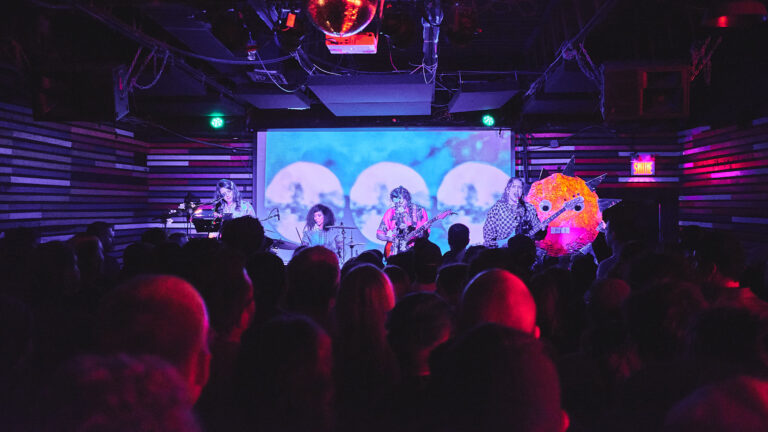
While some might value a cohesive evening of music above all else, I’ve personally never had a problem with three wildly different acts sharing the stage for an evening. This was the exact situation in the dimly lit, intimate setting of Quai des Brumes, where we gathered for an eclectic mix of electronic, college rock, and throwback pop.

The evening’s biggest surprise came early on with Sun Entire, a three-piece that far exceeded the sum of its parts. What could have made for sombre listening (thanks in large part to the gutwrenching vocals from poet-singer June Moon) was brought to life by irresistible trip-hop beats from Ivann Urueña and dialed guitar from Nico Serrus. Harkening back to the crunchy breakbeats and airy rhythms of 2000s pop rock, Sun Entire walked on a razor’s edge between deeply emotional ballads and downright groovy dance numbers. By the end of their set, it was fair to say they had won the room over with a sound that none of us had ever heard before.

Next up, we had The Wesleys, who you’ve probably heard of if you’ve been to any Montreal show in the past year. Young and with seemingly boundless energy, this group is the definition of good, clean fun—like a college party band all grown up and aiming for the big time. With all four members taking turns singing on the mic and the tempo never dipping for long, it’s hard to find anything to dislike about The Wesleys and their unique blend of indie-pop rock and punk. Like every other time I’ve seen them, The Wesleys looked completely stoked to be playing—an energy that was easily reciprocated by the rest of us.

Lastly, we had an exceptional set from our main attraction, Karma Glider. There is something about this act that feels distinctly modern, yet also so firmly rooted in the traditions of indie rock from a decade or two ago. Evoking sounds from Oasis and The Killers, frontman Susil Sharma brings something unique with his laid-back, effortless vocal delivery and his weirdly nonchalant, blisteringly fast guitar licks. The band oozed confidence, inviting us into a wash of jangly tones and throaty bass that feels so easy to get lost in—like losing track of time on a summer afternoon. On initial listening, Karma Glider might seem simple—easy music for easy listening—but this live set showed the true craft and talent working behind the scenes of this elegant, sunshiney ensemble. 

In the end, it was a warm, balmy, hazy summer’s eve with the music to match, and I’d recommend any combination of The Wesleys, Sun Entire, and Karma Glider to those in search of sounds to fit the season.

PAN M 360 At FIJM I The Cinematic Orchestra’s mystifying, live movie world

by Stephan Boissonneault

I had a weird junior high experience when I struggled with identity, and through that time, sometimes I needed to have an escape. That came in the form of The Cinematic Orchestra’s 2001 album, Man With A Movie Camera, which I played on repeat on my home computer and my mp3 Sony Bean device. So it’s safe to say that I felt rather nostalgic when The Cinematic Orchestra took to the Jazzfest main stage to fully play that album live on Saturday night, the concluding day of Jazzfest.

I truly have only listened to two of The Cinematic Orchestra’s albums, but I never imagined I would ever experience them live. I also had no real drive to see them live because, to me, their music seemed like it was served best on recording, where you listen to the scores of imaginary movies inside of your own head. Damn, was I wrong.

One aspect you need to understand about The Cinematic Orchestra is there are a lot of moving parts; constant jazzy drums, a flourishing of synths and samples, tight upright double bass, and the pièce de résistance, the live video art created by founder, Jason Swinscoe. While the band is building the songs, Swinscoe switches between two cameras that are hooked up to a projector and manipulates his footage live; throwing on kaleidoscopic imagery, and warping effects, all shot in black in white to create a silent movie vibe. He also sometimes jams with a typewriter as the nu jazz plays in the background, the typing sound effects sometimes in tune with the drums or keyboards and narrating the projector images in real-time.

I’ve never seen a show like this and the music was fantastic, filled with a whirlwind of riffs that stay with you after a first listen, but the visual component is what’s worth writing about. Swinscoe is a master at videography, probably a guy who has hundreds of film cameras in his home, knowing when to improvise and involve the crowd. The most memorable moments happened during the encore where Swinscoe shot the crowd with a cascading effect as bodies upon bodies, faces upon faces, all slowly crashed into each other while the hit track “To Build A Home,” played. It was truly majestic and words cannot do it justice.

Brazilian / Samba

The Gilsons have won the hearts of Montrealers

by Sandra Gasana

Before the Gilsons trio, who are famous in Brazil, take the stage, their percussionist Ricardo Guerra and trumpeter Osiel Junior first settle in before welcoming José, João and Francisco Gil, to the applause of a mostly Brazilian audience. All dressed in blue and white for the occasion, the three descendants of Gilberto Gil have an undeniable complicity on stage, which makes for a pleasant atmosphere from the outset.

They start the show with Pra gente acordar, featured on the album of the same name, released in 2022. At center stage, Francisco sings most of the songs, with José and João, sometimes on backing vocals, sometimes just on guitar and/or bass. It’s fascinating to see them swapping guitars throughout the show, a veritable musical chair, but with guitars. They continue with Algum ritmo, a collaboration with Jovem Dionisio.

In fact, they’re not all sons of Gilberto Gil, as I thought, but only José is the son, while João and Francisco are grandsons of the great Brazilian icon. “We’re happy to be here, for the first time in Canada,” José shares, before continuing with Vento Alecrim, from the 2018 album Varias Queixas. This opus fuses several styles such as samba, rap, funk, afoxé mixed with electronics.

For the track Vem de là, José takes the lead this time and the other two sing backing vocals, while encouraging the audience to sing along to Devagarinho, on which they collaborated with Mariana Volker. The three artists’ complicity is palpable throughout the concert. They teased each other, sometimes laughing in each other’s ears, and cracking jokes at every turn.

Another track the crowd seemed to enjoy was India, a collaboration with Julia Mestre. It’s João’s turn to repeat several times that they’re happy to be in Canada, that they never imagined their music would have brought them here, followed by a round of applause.

When they play the first notes of Swing de Campo Grande, the crowd starts screaming and bobbing to the beat. The same goes for Love, Love, on which they get the audience singing lalalala over a trumpet that’s delicious to the ear.

They alternate between the two albums, with A voz, or Proposta, which features some jaw-dropping solos by João. They couldn’t close the show without singing Varias queixas, the hit that put this trio on the map, as they say.

The encore came very quickly, with the audience shouting “Eu não vou embora” or “I am not going away” from the foot-tapping crowd, shaking the floor of the National. So they return to share Um so, Duas cidades and Voltar na Bahia, incorporating José’s cavaquinho, who also has fun on percussion at times, leaving the other two to dialogue with their guitar. They go on to cover a few samba classics, such as Dona Ivone Lara’s Alguém me aviso, much to the delight of the audience, who seem to appreciate the long encore. My personal favorite is João, whose voice most closely resembles that of Gilberto Gil, and who seems to be the trio’s rebel. And we all love a rebel, don’t we?

The opening act was Toronto-based Brazilian singer JØY Brandt, who shared several of her original compositions with the audience, such as her most recent track Vem. She also delighted the audience with a cover of the Edson Gomes classic Árvore, which she revisited with her own touch. She was accompanied for the occasion by musicians all originally from Bahia: percussionist and drummer The Real WheresBaiano, Bernardo on guitar and Luciano Vila Nova on bass. Of course, none of this would have been possible without Showzaço, and in particular Ulysses de Paula, who has been bringing high-calibre artists to Montreal for several years now. Between Emicida, Zeca Pagodinho, Nando Reis and soon Jorge Aragão in August, he no longer needs to prove himself. This visionary has become a key player in the Brazilian art scene in Canada.

Publicité panam
Modern Jazz

PAN M 360 at FIJM 2024 | George Coleman at Upstairs, the bet of an almost nonagenarian

by Alain Brunet

As long as we can’t testify to it, a concert by an octogenarian, or even a near-nonagenarian, is far from a guaranteed success. It may even be worse than Joe Biden’s most recent performance… Sometimes an old person can’t offer much except his own legend, so it’s best to stay at home. Fortunately, this was not the case for George Coleman, 89 years old and unstoppable! And not a single grey hair, we noted. We are well and truly at the dawn of trans-humanity!

Joking aside, this now mythical tenorman, a guest at Upstairs for two consecutive nights this week, was remarkably verbose, sitting comfortably in front of his tenor. On Thursday night, his small ensemble consisted of drummer Darrell Green and bassist Ira Coleman – no relation to his employer, and camping equipment is excluded from his circle of acquaintances.

Added to this core group is an ivory-haired guest, a Montrealer by adoption since he teaches at the university level: French pianist Jean-Michel Pilc accepts many challenges, including that of accompanying George Coleman, visibly pleased with this virtuoso contribution to his own Montreal stopover. It’s understandable. Pilc has an admirable command of the repertoire on offer here.

And what is this repertoire? Bebop and hardbop themes and harmonic progressions, polyrhythmic swing never far from the blues, and why not Some Day My Prince Will Come or even The Girl from Ipanema at the end of the set?

Roughly speaking, as we leave this generous and very sympathetic set, George Coleman’s phrases certainly don’t have the tone of his heyday (50s and 60s), but that doesn’t mean they deflate during performance. The old wizard’s sax sounds are less robust and agile, but rich, round, beautiful and wise.

Publicité panam
Publicité panam

PAN M 360 at FIJM 2024 | Makaya McCraven Becomes Headliner

by Alain Brunet

Under the guidance of visionary drummer and composer Makaya McCraven, a Chicago musician of whom I’ve been a thurifer for some years now, we were treated on Friday to rereadings of his recent material, especially the material from the album In These Times, released the fall following his FIJM residency in July 2022. Fewer surprises, less astonishment, less excitement, but just as much quality and brilliance in the playing. Just as much competence in the personnel put forward.

One can only imagine the delight of jazzophiles at their first encounter with this music played in real time! Théâtre Jean Duceppe was about 90% full, for a performance lasting about an hour and a half.

There was Joel Ross, obviously a vibraphone virtuoso, who had the opportunity to show off his two-mallet skills. Marquis Hill, trumpet, fulfilled all the tasks requested by his employer, with whom he has been working for some time; the exposition of the themes was perfect, the solos circumspect, without any major sparkle.

Junius Paul, electric bass, is another loyal Makaya McCraven collaborator, and the main support for the extraordinary rhythmic figures generated by the drums. The bassist also knows how to sing, and will also express himself through his voice in Makaya McCraven’s excellent mashup of his music with that of the late Gil Scott Heron’s album I’m New Here, including audio extracts from the late poet, and also a chorus sung by Junius Paul.

As for harpist Brandee Younger, we’ve heard her in this environment before (both on record and on stage), and she also has a solo career. She was in MTL in July 2023, and her concert at Studio TD was a great success. On the Makaya side, the harpist is at one with the ensemble, both as a gifted soloist and as a generator of harmony. The aura of legendary harpist Alice Coltrane is not far away. Once again, the depth of the drummer, certainly one of the most innovative of the current period, was evident.

We can’t wait for Makaya McCraven’s next chapter, but there’s still time to enjoy what he’s put forward so far. Prior to the release of In These Times, the percussionist had been creating pieces inspired by electronic processes and repurposing them as instrumental music. On Friday evening, this impression was less strong, as was the case when listening to his latest album.

Why is that? The composer’s most recent work incorporates aesthetic codes much closer to modern jazz and jazz groove. The rhythmic foundations remain visionary, the melodic and harmonic approaches more conservative, and that’s probably why it works so well with music lovers. For the future, in any case, let’s be sure that Makaya McCraven will be a headliner in the territory he’s combing. Let’s rejoice: very few artists of such depth can claim such a status.

Publicité panam
Publicité panam
Subscribe to our newsletter

Inscription
Infolettre

"*" indicates required fields

Type of Suscribers